With this being the time of year for sickies, I've been re-examining the stuff I use. Hand sanitizer and antiviral spray are great for times when you cannot easily get to a sink and soap (like at the fair or the zoo) or after using a public restroom (those things are SO not clean). But using them frequently can cause a host of problems, including hampering the ability to fight germs if the alcohol kills the good bacteria in the stomach and mouth. So while I'm not throwing away the sanitizer and I still carry a can of Lysol in the car, I wanted to find something that would work without so many side-effects. I was researching homemade hair treatments- of all things- and came across this tidbit of info about vinegar and peroxide:
Vinegar mixed with hydrogen peroxide (H2O2) is used in the livestock industry to kill bacteria and viruses before refrigerated storage. A chemical mixture of peracetic acid is formed when acetic acid is mixed with hydrogen peroxide. Vinegar is being used in some Asian countries in an aerosol spray to control pneumonia. A mixture of five-percent acetic acid and three-percent hydrogen peroxide is commonly used.
A few years ago we had a group of missionaries come and stay with us, and they brought the rotovirus. I had never experienced it before (or since, hallelujah) and found myself spraying the crib mattresses and the bathtub several times a day with either Lysol or bleach water. Both were offensive to the nostrils (because no matter what kind of fragrance they try to add, that stuff still stinks) and I'm sure a menace to the septic tank and the material being sprayed. Peroxide can discolor some materials, so be cautious, but generally when we're talking about sickie germs, it's the bathroom where they congregate most.
Buy an empty spray bottle and label it so that it does not get used for anything else. Then mix
1 part 5% white vinegar
1 part 3% peroxide
if you want, a few drops of fragrance
Turn the nozzle until it is the finest mist you can get. Spray on surface and allow to sit for 5 minutes. Wipe off if desired (like the toilet seat, not only because no one wants a wet tuchus, but also so you don't get it on clothes and discolor them).

Does this look familiar? Click on the comment link in any posting and leave us some feedback- we'd love to hear from you!
Showing posts with label home. Show all posts
Showing posts with label home. Show all posts
Tuesday, January 27, 2009


Tuesday, November 4, 2008
Large Family Wisdom
I don't have the slightest idea how to embed a banner, so you'll just have to settle for an old-fashioned link. If you have any tips, share them. If you don't, there's lots of great idea booty up for grabs. ;)
Monday, August 11, 2008
Making-it-from-Scratch Monday
Today I am busy making up soap/cleaners, and though I’d go ahead and share that as my making it from scratch post. I’ve always used white vinegar for cleaning. I have read many blogs that not only do the same, but offered recipes for making your own cleaners. I think I should tell you that I try to use as many natural products as possible, but the reason is not the environment. I won’t blatantly wreck it, but my concerns are not headed by the health of the planet. My first motivation is my family. Not only just a general desire to see them kept as far away as possible from chemicals, but also because we have a daughter with PICA. This is the girl who ate the desiccant out of the shoe box from Wal-Mart and drank fluoride rinse in the bathroom. I get tired of calling Poison Control and then waiting to see if Child Services decides to follow up! My second concern is money. We have a very tight budget, and with the cost of everything going up, I’ve had to cut some corners. I’ve linked to the people who gave me the recipe if it was not my own.

Dishes:
• a jar of half Borax and Half Washing Soda
• a bottle of dish soap
• box of baking soda and sea salt mix
• jug of white vinegar
I think if I had to rate my appliances, the dishwasher would actually be first. We have very hard water and trying to wash dishes by hand leaves them with a slimy film. The advantages of the dishwasher are that it gets very hot, thus disinfecting the dishes and preventing the spread of germs (at least from dishes- they still find a way to share germs), it uses less water than I would to try and rinse and re-rinse to get that film off, and the washing soda and borax are both natural water softeners, so the dishes are actually much cleaner now than when I used the commercial dishwasher stuff.
I do add a few drops of dish soap along with the powdered mix because it helps to break the grease molecules. I used to buy the little gel packs that had a bit of soap in them for this reason. Dish soap is variable. Sometimes I like to try whatever the ladies at co-op are splitting for the month, but I often find these to be pricey. I have found some really great soaps and detergents that I just could not afford. White vinegar works great in the rinse aid dispenser.
The baking soda and salt are for my baking stones. Soap would be absorbed and then flavor everything made on them, so I just scrub with this mix made into a paste and rinse. Perfect!

Laundry
• white vinegar
• baking soda
• homemade laundry soap
• ammonia
• bleach
• fabric softener
* Palmolive
This was the first post I found that convinced me I was not crazy to try and make things myself. Stephanie had it on her blog, and I tried it and loved it. Here is the recipe:
1 bar soap, grated (I use Lazy Bee)
1 cup Borax
1 cup washing soda
1/4 cup Palmolive (my addition that really helped with the work cloths and oil stains)
Put grated soapin a gallon of water on the stove. Heat until soap melts. Add two more gallons of water and bring to a boil. Turn down heat and add Borax and washing soda. Whisk until completely dissolved. When cooled but not cold, pour into containers. I converted my large canning kettle into my soap kettle when it got one too many dings in it.
I use all-natural soaps for this because even Ivory breaks me out. This does increase the cost, but it is still much more economical that the allergen-free laundry products on the market. Another alternative for sensitive skin is to use powdered baby laundry soap (Dreft) when making the soap. But they charge a nice price for that as well! I am hoping this fall to try my hand at soap making. That would bring the cost back down and allow me to experiment with what works well. A batch of this lasts us about two weeks, so imagine the number of plastic bottles we are saving. That’s my contribution to the environment. ;)
Because of the smell of dairy cows that permeates clothing in the winter if a farmer does not turn his cows out, I do keep ammonia on hand for the really bad barn clothes. I have found, though, that white vinegar works on the regular work clothes. So does pre-treating with liquid dish soap for oily spots. I also bleach whites because it cuts down on body acne, toenail fungus, and athlete’s foot (TMI, I know). When someone sweats a lot it can cause all kinds of problems, and if the clothing isn’t treated just right the ailments can be near impossible to treat. I read somewhere that lemon juice works as a bleach alternative, so I’ll get a big bottle of that to try next shopping trip. For the vinegar, I saved a large laundry soap dispenser, which holds 2 ½ gallons, and it is so much more convenient for dispensing than trying to pour from a gallon jug. I also have a canister for the baking soda. I buy both of these items by the case at the discount grocery store. Once the cashier looked at me funny, like I was a terrorist making a bomb. The only thing I know you can make that explodes from 6 gallons of white vinegar and 24 boxes of baking soda is a science fair volcano. Wonder if the FBI is watching me.
I haven’t yet found an alternative to fabric softener that I like. I tried Ecover’s, but like their non-chlorine powdered bleach, it was way too expensive. Most of the alternative I have read about would break me out, so I use what works (which doesn’t cost a lot).

Hand Soap
• bottle of baby shampoo
My kids use soap like it’s going out of style. I found this giant shampoo pump bottle at a salvage grocery store and it has worked great, but they empty it in about a week! I decided to dilute the soap when I realized they were using so much because then the sink was always full of suds that would never go down (because someone is washing their hand every 20 minutes in a house this size). I also had trouble with my daughter eating the soap because it had pictures of almonds of cucumbers and melons on the front. I figured baby soap was a very safe choice. I pour one bottle into the pump and add water to the top. Then mix vigorously and done. It still cleans perfectly well. It’s a lot cheaper than soap refills or bars that get dropped and melt in the water.

Spray Cleaners
• Household Traditions
• Holy Cow cleaners
• Homemade concoctions
• Anything interesting
This one is wide open, because I make some, buy some, and am always changing it. I bought a plain spray bottle to put bleach solution in when we’re battling sickness. I also have one with a vinegar solution for general cleaning. I don’t have a picture of them, but Bren introduced me to the Holy Cow cleaners which are wonderful! They’re pretty, too, which can help when the kids are cleaning. Well, let’s be honest- color inspires adults, too! I also use some of the Household Traditions made by Tropical Traditions, which is one of our co-op suppliers. They have a bug spray that is so safe, you can spray it right on produce in the garden. I also use Ecover toilet bowl cleaner, which is comparable in price to the store stuff. For furniture polish, mix olive oil or grapeseed oil with a little lemon juice or essential oil (though you don’t want to make large batches and let them sit since the olive oil could go rancid).
I also believe some of the best disinfectants are the ones Yahweh has provided free- sun, wind, and rain. If the material will hold up to it, I put bedding (including the frame) outside after illness. It always amazes me that the free and natural products work the best, and yet man thinks he can improve on the Creator's design!

Dishes:
• a jar of half Borax and Half Washing Soda
• a bottle of dish soap
• box of baking soda and sea salt mix
• jug of white vinegar
I think if I had to rate my appliances, the dishwasher would actually be first. We have very hard water and trying to wash dishes by hand leaves them with a slimy film. The advantages of the dishwasher are that it gets very hot, thus disinfecting the dishes and preventing the spread of germs (at least from dishes- they still find a way to share germs), it uses less water than I would to try and rinse and re-rinse to get that film off, and the washing soda and borax are both natural water softeners, so the dishes are actually much cleaner now than when I used the commercial dishwasher stuff.
I do add a few drops of dish soap along with the powdered mix because it helps to break the grease molecules. I used to buy the little gel packs that had a bit of soap in them for this reason. Dish soap is variable. Sometimes I like to try whatever the ladies at co-op are splitting for the month, but I often find these to be pricey. I have found some really great soaps and detergents that I just could not afford. White vinegar works great in the rinse aid dispenser.
The baking soda and salt are for my baking stones. Soap would be absorbed and then flavor everything made on them, so I just scrub with this mix made into a paste and rinse. Perfect!

Laundry
• white vinegar
• baking soda
• homemade laundry soap
• ammonia
• bleach
• fabric softener
* Palmolive
This was the first post I found that convinced me I was not crazy to try and make things myself. Stephanie had it on her blog, and I tried it and loved it. Here is the recipe:
1 bar soap, grated (I use Lazy Bee)
1 cup Borax
1 cup washing soda
1/4 cup Palmolive (my addition that really helped with the work cloths and oil stains)
Put grated soapin a gallon of water on the stove. Heat until soap melts. Add two more gallons of water and bring to a boil. Turn down heat and add Borax and washing soda. Whisk until completely dissolved. When cooled but not cold, pour into containers. I converted my large canning kettle into my soap kettle when it got one too many dings in it.
I use all-natural soaps for this because even Ivory breaks me out. This does increase the cost, but it is still much more economical that the allergen-free laundry products on the market. Another alternative for sensitive skin is to use powdered baby laundry soap (Dreft) when making the soap. But they charge a nice price for that as well! I am hoping this fall to try my hand at soap making. That would bring the cost back down and allow me to experiment with what works well. A batch of this lasts us about two weeks, so imagine the number of plastic bottles we are saving. That’s my contribution to the environment. ;)
Because of the smell of dairy cows that permeates clothing in the winter if a farmer does not turn his cows out, I do keep ammonia on hand for the really bad barn clothes. I have found, though, that white vinegar works on the regular work clothes. So does pre-treating with liquid dish soap for oily spots. I also bleach whites because it cuts down on body acne, toenail fungus, and athlete’s foot (TMI, I know). When someone sweats a lot it can cause all kinds of problems, and if the clothing isn’t treated just right the ailments can be near impossible to treat. I read somewhere that lemon juice works as a bleach alternative, so I’ll get a big bottle of that to try next shopping trip. For the vinegar, I saved a large laundry soap dispenser, which holds 2 ½ gallons, and it is so much more convenient for dispensing than trying to pour from a gallon jug. I also have a canister for the baking soda. I buy both of these items by the case at the discount grocery store. Once the cashier looked at me funny, like I was a terrorist making a bomb. The only thing I know you can make that explodes from 6 gallons of white vinegar and 24 boxes of baking soda is a science fair volcano. Wonder if the FBI is watching me.
I haven’t yet found an alternative to fabric softener that I like. I tried Ecover’s, but like their non-chlorine powdered bleach, it was way too expensive. Most of the alternative I have read about would break me out, so I use what works (which doesn’t cost a lot).

Hand Soap
• bottle of baby shampoo
My kids use soap like it’s going out of style. I found this giant shampoo pump bottle at a salvage grocery store and it has worked great, but they empty it in about a week! I decided to dilute the soap when I realized they were using so much because then the sink was always full of suds that would never go down (because someone is washing their hand every 20 minutes in a house this size). I also had trouble with my daughter eating the soap because it had pictures of almonds of cucumbers and melons on the front. I figured baby soap was a very safe choice. I pour one bottle into the pump and add water to the top. Then mix vigorously and done. It still cleans perfectly well. It’s a lot cheaper than soap refills or bars that get dropped and melt in the water.

Spray Cleaners
• Household Traditions
• Holy Cow cleaners
• Homemade concoctions
• Anything interesting
This one is wide open, because I make some, buy some, and am always changing it. I bought a plain spray bottle to put bleach solution in when we’re battling sickness. I also have one with a vinegar solution for general cleaning. I don’t have a picture of them, but Bren introduced me to the Holy Cow cleaners which are wonderful! They’re pretty, too, which can help when the kids are cleaning. Well, let’s be honest- color inspires adults, too! I also use some of the Household Traditions made by Tropical Traditions, which is one of our co-op suppliers. They have a bug spray that is so safe, you can spray it right on produce in the garden. I also use Ecover toilet bowl cleaner, which is comparable in price to the store stuff. For furniture polish, mix olive oil or grapeseed oil with a little lemon juice or essential oil (though you don’t want to make large batches and let them sit since the olive oil could go rancid).
I also believe some of the best disinfectants are the ones Yahweh has provided free- sun, wind, and rain. If the material will hold up to it, I put bedding (including the frame) outside after illness. It always amazes me that the free and natural products work the best, and yet man thinks he can improve on the Creator's design!
Thursday, July 10, 2008
Truly Blessed
Sorry for the sideways picture- I forgot to edit before I saved!

Here are some updated pictures of my store cupboard. I still haven't painted it or put doors on it, but this is what those massive shelves were meant for. The open bottom holds 20 food-grade buckets. These buckets house the wheat, rye, barley, oats, corn, lentils, splitpeas, pintos, and any other large amount of dry goods I come across. The next shelf up is for my baking essentials. I have a canisters for some of the things below (rice, oats, beans) so that I don't have to dig out a bucket every time, as well as canisters for flour, palm shortening, turbinado sugar, corn startch, and others. This is also where I keep my scale.

The third shelf is for canned goods like tomatoes, tuna, and salmon, that are bought by the case. I have my popcorn here, cases of Lundberg wild rice mix, thin cakes, and currently some of my mini clocks, while the hutch that houses them is moved! ;) The top shelf holds jars, both full and empty, coffee, tea, oil, vinegar, paper plates, and extra zip-lock bags. Yesterday was co-op day, and when we got all the items put away, I noticed how nice and full the store cupboard looked. What a blessing to have such abundance. It is a testament to Adonai's lovingkindness.

And you might be wondering how I took these pictures with a broken camera.....my darling helps out other farmers when they want to go on vacation or need surgery. We always wished there were people like that when we were milking. As it was, my dad had to take off work to milk for us so we could have a 2 day honeymoon. My husband is a very understanding person, and doesn't always get paid in cash. We know what cash flow can be like between milk checks and having to buy feed, pay the vet, etc. He is gracious to accept whatever they offer, which is sometimes gifts they have received themselves like gift cards. We have been paid in grocery store certificates and Wal-Mart cards many a time. And he lovingly passed the blessing on to me this time and told me to go ahead and get my birthday present (early) of a new camera. I felt horribly guilty, which is something I have trouble with when I know how tight the money is and how hard he works. He told me not to scrimp, as there were problems using the old camera because it was so cheap (no zoom and often trouble attaching it to the computer). I was very deliberate in what I wanted. Multi-purpose is always great, so I wanted one with the video option. I also wanted the kind that you can watch on the screen as you zoom in so that I didn't have to either scratch my glasses trying to look through the view box or take my glasses off and not know what I was looking at! I also wanted a color other than silver, because the 'regular' camera is silver, and it was always confusing to the kids when I would ask them to bring me the digital camera. What I found was this one. I really liked the idea of a pink camera, but did not want to be selfish and force my husband to also use a pink camera, so I opted for the blue. This camera also has a memory card that slides right into the front of my printer, so I don't have to install any camera software and fight with it to run properly! We found it on sale, and with a discount, got it for LESS than the first digital camera that wasn't nearly as good.
And to add to the blessing pile, Yahweh sent us an unexpected check so we were able to fix the AC in the house. Our house is a ranch with no basement or attic, so there is nowhere for the heat to go. The AC stopped working last year, but we just didn't have the money to fix it, so we suffered. One night last summer we went to bed at 10:00 PM and it was 98* in the hallway. No kidding! We also noticed the asthmatic kids had a harder time without it, not only because hot humid air is harder to breath, but because the windows were open when we mowed grass, sending the pollen inside. My darling finally said we needed to find out, and if it was too much we should at least get a window unit for the girls' room. It turned out to be just a bad thermostat, so we were suffering for nothing because that was a very cheap fix. That meant we had the money to buy my darling some jeans and work boots, which he desperately needed, and the kids all got new underwear. Our G-d is an AWESOME G-d!

Here are some updated pictures of my store cupboard. I still haven't painted it or put doors on it, but this is what those massive shelves were meant for. The open bottom holds 20 food-grade buckets. These buckets house the wheat, rye, barley, oats, corn, lentils, splitpeas, pintos, and any other large amount of dry goods I come across. The next shelf up is for my baking essentials. I have a canisters for some of the things below (rice, oats, beans) so that I don't have to dig out a bucket every time, as well as canisters for flour, palm shortening, turbinado sugar, corn startch, and others. This is also where I keep my scale.

The third shelf is for canned goods like tomatoes, tuna, and salmon, that are bought by the case. I have my popcorn here, cases of Lundberg wild rice mix, thin cakes, and currently some of my mini clocks, while the hutch that houses them is moved! ;) The top shelf holds jars, both full and empty, coffee, tea, oil, vinegar, paper plates, and extra zip-lock bags. Yesterday was co-op day, and when we got all the items put away, I noticed how nice and full the store cupboard looked. What a blessing to have such abundance. It is a testament to Adonai's lovingkindness.

And you might be wondering how I took these pictures with a broken camera.....my darling helps out other farmers when they want to go on vacation or need surgery. We always wished there were people like that when we were milking. As it was, my dad had to take off work to milk for us so we could have a 2 day honeymoon. My husband is a very understanding person, and doesn't always get paid in cash. We know what cash flow can be like between milk checks and having to buy feed, pay the vet, etc. He is gracious to accept whatever they offer, which is sometimes gifts they have received themselves like gift cards. We have been paid in grocery store certificates and Wal-Mart cards many a time. And he lovingly passed the blessing on to me this time and told me to go ahead and get my birthday present (early) of a new camera. I felt horribly guilty, which is something I have trouble with when I know how tight the money is and how hard he works. He told me not to scrimp, as there were problems using the old camera because it was so cheap (no zoom and often trouble attaching it to the computer). I was very deliberate in what I wanted. Multi-purpose is always great, so I wanted one with the video option. I also wanted the kind that you can watch on the screen as you zoom in so that I didn't have to either scratch my glasses trying to look through the view box or take my glasses off and not know what I was looking at! I also wanted a color other than silver, because the 'regular' camera is silver, and it was always confusing to the kids when I would ask them to bring me the digital camera. What I found was this one. I really liked the idea of a pink camera, but did not want to be selfish and force my husband to also use a pink camera, so I opted for the blue. This camera also has a memory card that slides right into the front of my printer, so I don't have to install any camera software and fight with it to run properly! We found it on sale, and with a discount, got it for LESS than the first digital camera that wasn't nearly as good.
And to add to the blessing pile, Yahweh sent us an unexpected check so we were able to fix the AC in the house. Our house is a ranch with no basement or attic, so there is nowhere for the heat to go. The AC stopped working last year, but we just didn't have the money to fix it, so we suffered. One night last summer we went to bed at 10:00 PM and it was 98* in the hallway. No kidding! We also noticed the asthmatic kids had a harder time without it, not only because hot humid air is harder to breath, but because the windows were open when we mowed grass, sending the pollen inside. My darling finally said we needed to find out, and if it was too much we should at least get a window unit for the girls' room. It turned out to be just a bad thermostat, so we were suffering for nothing because that was a very cheap fix. That meant we had the money to buy my darling some jeans and work boots, which he desperately needed, and the kids all got new underwear. Our G-d is an AWESOME G-d!
Monday, June 2, 2008
Working On Things
I've been out for a bit, and it's because I have been preoccupied both emotionally and physically. The death of Steven Curtis Chapman's daughter was something of a big deal for me. Not just because we met him and shared adoption stories and have worked as ministry partners with their organization, but because it caused me to do a lot of reflecting on my own situation. I had to answer to myself as to whether I would have that level of grace for my son had he been the driver and whether my difficult kids would know they were as loved as Maria did if they were to die, and I really didn't like the answers. That little sin voice that tries to allow you to justify things kept saying it is different when you adopt older kids, and the situation is dramatically different, but that is not an excuse for so much bitterness. This struggle is also why little Jeremiah's passing hit me so hard, even thought I had not know his family before this time. The guilt is so consuming. When Jacob wrestled with Yahweh, at least he only had to endure one night! I feel like I have been wrestling him for a year and I am exhausted.
We have also been especially busy on the farm, which is good because I can work with my hands while I am working through things in my head. We have piled on the projects this year. I needed 9 more raised beds, a whole section plowed for large crops, and I broke the rule of mesh fencing by deciding to move it. Electric fence and even barbed wire can be moved with minimum trouble, but the wire mesh fencing always ends up attached to the ground because top soil accumulates and grass grows up through it. We spent two whole day just pulling the fence off the ground. But we decided to put the garage where my chicken fence used to be, so it had to go. I like the new location a lot more. I put in the posts and hung the fence on my own while Gary was out plowing. Well, a few of the kids were there to help, so it was the same as doing it alone only harder because I had to keep them out of the way while still keeping them in view.
 thou shall not move mesh fencing
We also switched chicken buildings. My dad had built me a little hen house shaped like the barn roof, but I have way more chickens now. My father-in-law used to have this red shed in back for his lawnmower and when they demolished the house, I saved it. We had bikes in it for a while, but with no doors we always ended up with critters as well, so I decided to make it my new coop. That took hours of work as well, since chickens must be protected at night. I cut the rotting bottom 18 inches of particle board out and put in hardware cloth. That way I have good ventilation and sturdy protection. I also put on a screen door. I still have to finish my roosting bars and nest boxes, and I'd like to either side it or paint it, but the chickens were finally allowed out!
 my beautiful buff orpington chickens
Then we planted the corn and potatoes. Just as we were finishing the baby stepped on a board with a rusty nail in it, and she was bleeding a lot. So I got to spend the evening (and half the night) in the ER with her. Weekend evening at the hospital- everything went SUPER slow. She was such a good girl and so brave, even when she got really hungry and really tired. The nurses were all talking about her at the desk, so others had to come see her and she ended up with a bag full of books, beanies, and toys. No one could believe how good she was. They didn't even have to tie her in that papoose thing to give her the shots of Novocaine in her foot or to clean it out. Thank goodness she didn't need a tetanus update. I am leery about vaccines as well, but that is one I keep my kids current on because of where we live. An Amish boy near here got lockjaw from a thorn, so I'm especially careful with those boosters. When we finally got out of there, we had to go to the 24 hour pharmacy, so I found myself watching a movie and eating a TV dinner with my darling at 2:30 in the morning! Now my sleep is all off and that usually means a migraine, so I'm trying to take it easy.
 planting taters
We have several more things to get done, so I'll be putting those up as they happen. I seem to post in spurts- when I'm reading prophecy it's all prophecy, when I'm looking for school equipment, it's all school stuff. For now, it will most likely be organizing and finishing the list of jobs I wanted done by June 1st (hahaha).
We have also been especially busy on the farm, which is good because I can work with my hands while I am working through things in my head. We have piled on the projects this year. I needed 9 more raised beds, a whole section plowed for large crops, and I broke the rule of mesh fencing by deciding to move it. Electric fence and even barbed wire can be moved with minimum trouble, but the wire mesh fencing always ends up attached to the ground because top soil accumulates and grass grows up through it. We spent two whole day just pulling the fence off the ground. But we decided to put the garage where my chicken fence used to be, so it had to go. I like the new location a lot more. I put in the posts and hung the fence on my own while Gary was out plowing. Well, a few of the kids were there to help, so it was the same as doing it alone only harder because I had to keep them out of the way while still keeping them in view.
 thou shall not move mesh fencing
We also switched chicken buildings. My dad had built me a little hen house shaped like the barn roof, but I have way more chickens now. My father-in-law used to have this red shed in back for his lawnmower and when they demolished the house, I saved it. We had bikes in it for a while, but with no doors we always ended up with critters as well, so I decided to make it my new coop. That took hours of work as well, since chickens must be protected at night. I cut the rotting bottom 18 inches of particle board out and put in hardware cloth. That way I have good ventilation and sturdy protection. I also put on a screen door. I still have to finish my roosting bars and nest boxes, and I'd like to either side it or paint it, but the chickens were finally allowed out!
 my beautiful buff orpington chickens
Then we planted the corn and potatoes. Just as we were finishing the baby stepped on a board with a rusty nail in it, and she was bleeding a lot. So I got to spend the evening (and half the night) in the ER with her. Weekend evening at the hospital- everything went SUPER slow. She was such a good girl and so brave, even when she got really hungry and really tired. The nurses were all talking about her at the desk, so others had to come see her and she ended up with a bag full of books, beanies, and toys. No one could believe how good she was. They didn't even have to tie her in that papoose thing to give her the shots of Novocaine in her foot or to clean it out. Thank goodness she didn't need a tetanus update. I am leery about vaccines as well, but that is one I keep my kids current on because of where we live. An Amish boy near here got lockjaw from a thorn, so I'm especially careful with those boosters. When we finally got out of there, we had to go to the 24 hour pharmacy, so I found myself watching a movie and eating a TV dinner with my darling at 2:30 in the morning! Now my sleep is all off and that usually means a migraine, so I'm trying to take it easy.
 planting taters
We have several more things to get done, so I'll be putting those up as they happen. I seem to post in spurts- when I'm reading prophecy it's all prophecy, when I'm looking for school equipment, it's all school stuff. For now, it will most likely be organizing and finishing the list of jobs I wanted done by June 1st (hahaha).
Tuesday, March 25, 2008
My Newest Gadget
I am the kind of girl who can spend a day window shopping at Lowe's (and I don't just mean for windows). I have some projects planned for this spring, but in the meantime I had this new shower head to install. I got it from Avon of all places! An elderly neighbor sells Avon and I try to buy something I can use once in a while to help support her. It has several different options, but the one that excited me most was the 'waterfall' as I have found that the longer my hair gets, the harder it is to rinse the shampoo out. It was fairly easy to install, too, once I figured out which way the thread of the old shower head went (some things are the standard "lefty-loosy, righty-tighty", and some are not!).


Monday, March 3, 2008
Slow Drain
One of the qualities of the virtuous wife in Provers that we aspire to as women of the Word is 'capable'. I think we should be able to do some simple repair jobs, understand basic maintenance on our vehicles, and in general be able to handle the little things that need doing when our husbands are not available. So I thought I'd share some of what I know in hopes that others would do the same and we can all learn a little!
A Slow Drain (or completely stopped-up sink)
If the water in your sink is starting to drain very slowly or it is completely void of movement, often the simplest solution is the one that works. There is a part of the piping called a 'trap' or 'U-bend'. Basically it is the part of the pipe that is bent. This serves not only to 'trap' things that might go down accidentally (like your wedding ring!) but also to prevent sewer gas from coming back up into your house. As a result, there is always water in this section of pipe and you will need a pan or bucket to catch the water.

It is best to get the water to drain first if you can, even if you must use a plunger (I have one reserved for sink use) but if you can't, it is OK. Just make sure you have a container large enough to hold the amount of water in your sink under the trap when you remove it. It is also best to avoid the chemicals they sell to pour down a drain because they are so toxic. They will also kill the bacteria in your septic tank, and a septic tank does not work properly without bacteria.
1. Loosen the trap from the pipes at both ends. It will have a large nut-like attachment of some kind that threads and locks to the pipes. If you have copper piping, you may need to use wrenches to loosen it. Plastic pipes usually have a wing nut type of attachment that allow for leverage to turn the nut without any tools. You'll want to loosen one side a little, then the other side a little. If you completely loosen just one side, you will put pressure on the pipe. Try to hold the trap in place until you have it all the way freed so that water does not start to spray out the side into your face!
2. When the trap is free, pull it down and allow any water to drain into your container. Leave it there to catch the drips that will come with draining.
3. Take your trap out to somewhere with good light and check inside. In my case, someone had stuffed Popsicle sticks and straws down the drain. I will have to check into that! Clean out anything that is stuck in the trap and wash it well with dish soap. Washing it with a soap (which is a base) breaks the grease surface which will cling to any food particles or oils that go down the drain with washing dishes. It will keep your trap clean longer.

4. Before re-attaching, use a flashlight to check in the pipe for any other obstructions. Sometimes tall things will stack up above the trap (like straws!). Clean out anything you find and wipe your connections dry. * One exception to this would be some old pipes that use a never-seize or zinc to keep the connections from rusting together. If there is a grey 'slime' on your pipes and connectors, leave it there. Just gently pat dry any water spots.
5. Hold the trap in place while tightening the nuts, again doing a little on each side until both are tight. Have a bucket ready under your trap and try the connection by running water in the sink. There should be no leaks. If you have leaks, check that your nuts are properly tightened and not loose or cross-threaded.
6. It is obviously best to avoid anything going down the drain, but it is simply not always possible. Even tiny bits of food will stick together and create an obstruction. If you keep your trap cleaned it will help to prevent a larger mass forming down the line, where a snake will be needed and the headache of fixing it will be much greater!
Ta-da! You just cleaned that sink trap by yourself. You are a very capable wife.
A Slow Drain (or completely stopped-up sink)
If the water in your sink is starting to drain very slowly or it is completely void of movement, often the simplest solution is the one that works. There is a part of the piping called a 'trap' or 'U-bend'. Basically it is the part of the pipe that is bent. This serves not only to 'trap' things that might go down accidentally (like your wedding ring!) but also to prevent sewer gas from coming back up into your house. As a result, there is always water in this section of pipe and you will need a pan or bucket to catch the water.

It is best to get the water to drain first if you can, even if you must use a plunger (I have one reserved for sink use) but if you can't, it is OK. Just make sure you have a container large enough to hold the amount of water in your sink under the trap when you remove it. It is also best to avoid the chemicals they sell to pour down a drain because they are so toxic. They will also kill the bacteria in your septic tank, and a septic tank does not work properly without bacteria.
1. Loosen the trap from the pipes at both ends. It will have a large nut-like attachment of some kind that threads and locks to the pipes. If you have copper piping, you may need to use wrenches to loosen it. Plastic pipes usually have a wing nut type of attachment that allow for leverage to turn the nut without any tools. You'll want to loosen one side a little, then the other side a little. If you completely loosen just one side, you will put pressure on the pipe. Try to hold the trap in place until you have it all the way freed so that water does not start to spray out the side into your face!
2. When the trap is free, pull it down and allow any water to drain into your container. Leave it there to catch the drips that will come with draining.
3. Take your trap out to somewhere with good light and check inside. In my case, someone had stuffed Popsicle sticks and straws down the drain. I will have to check into that! Clean out anything that is stuck in the trap and wash it well with dish soap. Washing it with a soap (which is a base) breaks the grease surface which will cling to any food particles or oils that go down the drain with washing dishes. It will keep your trap clean longer.

4. Before re-attaching, use a flashlight to check in the pipe for any other obstructions. Sometimes tall things will stack up above the trap (like straws!). Clean out anything you find and wipe your connections dry. * One exception to this would be some old pipes that use a never-seize or zinc to keep the connections from rusting together. If there is a grey 'slime' on your pipes and connectors, leave it there. Just gently pat dry any water spots.
5. Hold the trap in place while tightening the nuts, again doing a little on each side until both are tight. Have a bucket ready under your trap and try the connection by running water in the sink. There should be no leaks. If you have leaks, check that your nuts are properly tightened and not loose or cross-threaded.
6. It is obviously best to avoid anything going down the drain, but it is simply not always possible. Even tiny bits of food will stick together and create an obstruction. If you keep your trap cleaned it will help to prevent a larger mass forming down the line, where a snake will be needed and the headache of fixing it will be much greater!
Ta-da! You just cleaned that sink trap by yourself. You are a very capable wife.
Thursday, January 31, 2008
Parking Lot Blues

Do you put the cart back when you are done with it at the grocery store? (or for my Australia friends, the trolley)
I have found this to be a source of stress for me lately (I'm just creating stress to add to the stress I already experience!). Growing up, we shopped at the store in town, which was a very small store (no Super Wal-Marts or anything then). It had a very small parking lot and it was a very small town. As we got older, taking the cart back up was a privilege. It meant we were old enough to watch traffic and cross the parking lot (albeit a two-row parking situation) and take the cart back in the store (because they didn't have the cart-corrals that everyone has today. It was almost a right of passage. (I also remember taking the glass coke bottles in for an 80 cent credit slip, but that's a different 'long ago' story)
When I was in college and out on my own for the first time, I still returned the cart to the store (again, still no Super-anything stores with cart corrals). It felt like a task a responsible person would carry out. Why leave the cart in the lot for someone else to have to fetch, or have it roll into another car, or whatever? I was being responsible and making sure the property I had borrowed was brought back.
Then I had a baby. There was no way in Hades I was gonna leave that baby alone in the car while I returned the cart. But I still felt guilty, and there still weren't cart returns, so I would unload my groceries and then go back in the store with the baby and return the cart, carry her out, and leave. This worked until I had more than one child small enough to ride in the cart. When we got our first adoption set (we had other sibling groups, but these were younger than any other kids we'd had) I had three little girls who definitely should not walk through a parking lot alone, and two kids who could hold hands and hold onto the cart, but who should not be given the responsibility of holding on to a little girl. So I had no way to return the cart and then get everyone back to the car unless I left my purse with the groceries I had unloaded, and that was a scary thought. I imagined creeps lurking in the shadows waiting for me to leave my valuable merchandise and my purse (with keys) in the car so they could run off with my belongings.
Fortunately by this time they were beginning to put cart returns in parking lots (this may have been going on for 50 years elsewhere, but around here change comes a LONG time later) but they were always about 5 spaces form any available parking space. So I would unload groceries, kids, and purse in the car, lock the doors (taking the keys with me), walk the cart to the return (walking sideways so as to keep an eye on the kids), ditch the cart and RUN back to the car. It was nerve-wracking!
As the oldest two reached the age of about 9, I decided to let them take the cart to the corral. After all, by their age I was going in the store with a short list and money and doing the shopping for my mother while she sat in the car with the babies (again in a very small town and a very different time). But the crazy driving of some people even in parking lots began to make me wary of letting them walk behind cars when they were still so short. One time I had to hit a guy's back window to keep him from running over the whole family as we walked behind him. He had come out of the store after us, jumped in his car while turning the key, threw it in reverse and started rolling it, and I just thought to myself "Where the heck is he going in such a hurry?" Too many young people think the road is their own personal drag strip.
Anyway, then came the first Super Wal-Mart. Oh, the excitement of having everything in one store, and the prices were great for our growing family. But the parking lot the size of our little town's entire plaza was intimidating, and there are like 5 cart returns in the whole lot. You have to walk a great distance to get to the cart corrals, and with (now) 7 little ones, I wasn't about to try the lock and run again. I just started ditching the cart! The guilt is still very real and immediate. I look around to make sure no one is watching as I let go of that cart handle and get in my vehicle. And as much as I try to justify it as not my fault because the way the parking lot and the world are being run, I still feel that pang of being irresponsible and negligent with borrowed property!
Tuesday, January 1, 2008
Treasure Trove
When my mother-in-law died, there was a bit of a hurry to get things out of her house. It had been eaten by termites and was therefor given to the fire department to burn down. So not everything was super-sorted at the time, and for years we have had boxes of her belongings in our bedroom, closet, and bathroom. My husband has been very wary of going through them. I think part of it was knowing that he would be getting rid of some things, and then also knowing when we finished sorting these boxes, we would be done with the sorting through of her life forever. It would complete that part of his life. I have not pushed him at all, knowing how attached I am to things from my grandmother (I have one of her snuff cans in my fancy china cabinet!) and just waited for him to be ready. Today, out of the blue, he got one of the boxes down and said "Might as well start somewhere" (we are in the middle of a snow storm, so he offered to help me clean/organize today). What we found in that box is amazing, both cherished memories and really exciting finds. I wanted to share some of them:
First is the bill from the caterers for my husband's graduation party.
Graduation Party for Gary ____________
June 2 (60-65 persons)
Potato Salad:
10# potatoes $2.49
Onions (3 large) .39
Celery (1 bunch) .49
Salad Dressing (1/2 gallon) .90
Eggs 1 1/2 dozen .89
Macaroni Salad:
Macaroni (2 lb) $0.95
Eggs (1/2 dozen) .29
Onion (3 small) .29
Celery (1 bunch) .49
Salad Dressing (from above) .00
Baked Beans:
2 gal. beans $4.95
Onions (from above) .00
Ketchup 1.00
Brown Sugar (1 lb.) .29
Cold Cuts:
Ham $9.36
Lebanon Bologna 7.60
80 buns 4.30
Swiss Cheese 3.30
Colby Cheese 3.10
Relish Trays:
Celery (3 bunches) $1.77
Carrots (2 packages) .49
Radishes (4 packages) .78
Pickles (sweet) 1.00
Pickles (dill) 1.00
Olives (ripe 3) 1.77
Olives (stuffed 2) 2.98
Green Onions (donated) .00
TOTAL: $51.87
Now we assume by the precise tallies, and the lack of a labor cost, that it was a neighbor lady who did it, though she made up a very nice invoice! But that makes it all the greater, because we can see the prices of things and just how much they have changed (or not changed).

Another neat find was this 1938 The Housewife's Almanac (yes, that is the top of my washer). It amazed me to find information about the necessary 'bacteria' our intestines need and how the move to processed food has eliminated those 'creatures' and caused a host of intestinal 'complaints'. People are writing about this stuff now and saying it is new or cutting edge. It does have a list of zodiac signs and yearly horoscopes (yuck) but it has a lot of very good recipes and information on preparing food in the Nourishing Traditions way (though obviously that is our term for it and this was written BEFORE NT).

Next I have a Gold Medal Flour Cookbook from 1917. The binding was the first thing that caught my eye, being almost a paper-on-leather format with a definite leather spine. I do not know enough about the history of this flour to determine if it was processed heavily, but other recipes in this book are JUST what I would love to find: dandelion greens, mutton (good luck finding any recipes for mutton in any newer cookbook), real custards, game meats, sourdough bread (with their flour, of course!), tongue jelly, sweetbreads (does any even know what that IS anymore?), forcemeat, and more. I could spend a whole day just reading this book and probably a year trying out the recipes.

And this was my mother-in-law's recipe box. Inside I found an order form for food flavorings that are made with 'pure, concentrated fruits'. Obviously, the company is no longer in business because you can't do real food for the same cost as chemical fake-itives. There are some really yummy recipes in here, but without that real flavoring, I bet there is no comparing. I'm going to see if I can find real flavorings from somewhere, maybe Frontier, so I can see what the cakes would have tasted like in the old days. YUMMY!!!!!
First is the bill from the caterers for my husband's graduation party.
Graduation Party for Gary ____________
June 2 (60-65 persons)
Potato Salad:
10# potatoes $2.49
Onions (3 large) .39
Celery (1 bunch) .49
Salad Dressing (1/2 gallon) .90
Eggs 1 1/2 dozen .89
Macaroni Salad:
Macaroni (2 lb) $0.95
Eggs (1/2 dozen) .29
Onion (3 small) .29
Celery (1 bunch) .49
Salad Dressing (from above) .00
Baked Beans:
2 gal. beans $4.95
Onions (from above) .00
Ketchup 1.00
Brown Sugar (1 lb.) .29
Cold Cuts:
Ham $9.36
Lebanon Bologna 7.60
80 buns 4.30
Swiss Cheese 3.30
Colby Cheese 3.10
Relish Trays:
Celery (3 bunches) $1.77
Carrots (2 packages) .49
Radishes (4 packages) .78
Pickles (sweet) 1.00
Pickles (dill) 1.00
Olives (ripe 3) 1.77
Olives (stuffed 2) 2.98
Green Onions (donated) .00
TOTAL: $51.87
Now we assume by the precise tallies, and the lack of a labor cost, that it was a neighbor lady who did it, though she made up a very nice invoice! But that makes it all the greater, because we can see the prices of things and just how much they have changed (or not changed).

Another neat find was this 1938 The Housewife's Almanac (yes, that is the top of my washer). It amazed me to find information about the necessary 'bacteria' our intestines need and how the move to processed food has eliminated those 'creatures' and caused a host of intestinal 'complaints'. People are writing about this stuff now and saying it is new or cutting edge. It does have a list of zodiac signs and yearly horoscopes (yuck) but it has a lot of very good recipes and information on preparing food in the Nourishing Traditions way (though obviously that is our term for it and this was written BEFORE NT).

Next I have a Gold Medal Flour Cookbook from 1917. The binding was the first thing that caught my eye, being almost a paper-on-leather format with a definite leather spine. I do not know enough about the history of this flour to determine if it was processed heavily, but other recipes in this book are JUST what I would love to find: dandelion greens, mutton (good luck finding any recipes for mutton in any newer cookbook), real custards, game meats, sourdough bread (with their flour, of course!), tongue jelly, sweetbreads (does any even know what that IS anymore?), forcemeat, and more. I could spend a whole day just reading this book and probably a year trying out the recipes.

And this was my mother-in-law's recipe box. Inside I found an order form for food flavorings that are made with 'pure, concentrated fruits'. Obviously, the company is no longer in business because you can't do real food for the same cost as chemical fake-itives. There are some really yummy recipes in here, but without that real flavoring, I bet there is no comparing. I'm going to see if I can find real flavorings from somewhere, maybe Frontier, so I can see what the cakes would have tasted like in the old days. YUMMY!!!!!
Thursday, June 21, 2007
Allo', Allo'?
I know it's an odd title. It's a British Comedy that I used to love to watch on BBC(it is so sinful that I could not recommend anyone watch it, but the title is now stuck in my head forever!) and I needed a title to go with what I had to show you today.
My husband just received his new phone! It is called a CapTel Phone. Now I am guessing that everyone has seen those TTY phones that look like a typewriter with a phone dock on top. That is how deaf people would communicate by phone, and it was such a blessing, though not so easy if you can't type. My husband types about three words a minute and is miserable doing it. When we started to realize we were going to need something other than the specialty phone with the VERY high decibel range (you don't want to try and use one of those if you have normal hearing) I was afraid we would be stuck with a TTY and he would therefore not be able to communicate effectively. I had researched some things online and then called the operator to see where you begin with phone services for the hearing impaired. She said the first step was purchasing a phone, and that there were newer option out there.
One of the newer phones I found on the website she showed me was a one-way TTY, so the people calling us would talk, the operator would type their words, and Gary could read them and respond vocally. This way he wouldn't have to type at all. The cost was $240 plus shipping, but you know he is worth any cost! I also found an even better (in my opinion) option, which is the CapTel.
This phone has a screen that displays what the caller is saying to you as well as allowing you to hear the conversation. Since Gary is not completely deaf yet, this would give him a chance to hear if someone is yelling, or laughing (assuming they do it loud enough) and give the conversation a lot more meaning than just a script. I was saddened to see a price tag pf $499 plus shipping, but there was a side-note that if your state was listed in this red box area, they would give you the phone for $99 since they were trying out the new CapTel service lines. And guess what?!? There was Ohio!!!!!!!! So we got his new phone, which is the best phone we could have gotten, and we got it for less than $100! Go Ohio! (and those three other states- don't remember what they were)
This phone works in two modes. In mode one, you can call anyone and have captions appear. The down side is that someone calling you has to first call the CapTel line to be connected to the voice transcription software or there will be no captions. The other mode requires a second phone line, but any call can be captioned because the second line connects to the software. The down side of that is paying for a second phone line. We're still trying to decide which to use. In the meantime, Gary can call anyone and have captions. The phone is hard to read if it is lying down, though, so I came up with the idea to give Gary my cookbook stand. I took the phone plate, screwed it to the cookbook stand, and attached the phone. Now it is the perfect height and angle for Gary to read the screen while he is on the phone (he always has his special phone on his side of our bed). Yeah again!!!
My husband just received his new phone! It is called a CapTel Phone. Now I am guessing that everyone has seen those TTY phones that look like a typewriter with a phone dock on top. That is how deaf people would communicate by phone, and it was such a blessing, though not so easy if you can't type. My husband types about three words a minute and is miserable doing it. When we started to realize we were going to need something other than the specialty phone with the VERY high decibel range (you don't want to try and use one of those if you have normal hearing) I was afraid we would be stuck with a TTY and he would therefore not be able to communicate effectively. I had researched some things online and then called the operator to see where you begin with phone services for the hearing impaired. She said the first step was purchasing a phone, and that there were newer option out there.
One of the newer phones I found on the website she showed me was a one-way TTY, so the people calling us would talk, the operator would type their words, and Gary could read them and respond vocally. This way he wouldn't have to type at all. The cost was $240 plus shipping, but you know he is worth any cost! I also found an even better (in my opinion) option, which is the CapTel.

This phone has a screen that displays what the caller is saying to you as well as allowing you to hear the conversation. Since Gary is not completely deaf yet, this would give him a chance to hear if someone is yelling, or laughing (assuming they do it loud enough) and give the conversation a lot more meaning than just a script. I was saddened to see a price tag pf $499 plus shipping, but there was a side-note that if your state was listed in this red box area, they would give you the phone for $99 since they were trying out the new CapTel service lines. And guess what?!? There was Ohio!!!!!!!! So we got his new phone, which is the best phone we could have gotten, and we got it for less than $100! Go Ohio! (and those three other states- don't remember what they were)
This phone works in two modes. In mode one, you can call anyone and have captions appear. The down side is that someone calling you has to first call the CapTel line to be connected to the voice transcription software or there will be no captions. The other mode requires a second phone line, but any call can be captioned because the second line connects to the software. The down side of that is paying for a second phone line. We're still trying to decide which to use. In the meantime, Gary can call anyone and have captions.
 The phone is hard to read if it is lying down, though, so I came up with the idea to give Gary my cookbook stand. I took the phone plate, screwed it to the cookbook stand, and attached the phone. Now it is the perfect height and angle for Gary to read the screen while he is on the phone (he always has his special phone on his side of our bed). Yeah again!!!
Friday, May 18, 2007
Eureka! (well, Bissell, actually)
I've figured out the secret! When bagless vacuum cleaners came out, I thought it was a great idea. It made sense to me that a bag with holes in it would quickly clog and lose suction. It was also a cloud of dust every time I took the bag out, not to mention having to remember the model number so I could buy bags. So I bought a fairly cheap one (our regular had died- I wasn't just running out to buy the latest invention) and I got the Bissell powerforce. When I brought it home and tried it, the suction was amazing. I pulled things out of the carpet that had been there so long they were forgotten (like glitter) and I was very confident I was getting the allergens and critters out of the floor and making things safer for my asthmatic baby. I understood that the filters were washable, but it seemed that they were 'full' about half way through my vacuuming job. I would keep going, knowing I had to get done, because washing and drying the filter took about 48 hours. So my vacuum started to work less efficiently, then hardly at all and it made a growling noise. I also smelled the unmistakable dirt smell you find when someone is running an old vacuum.
I had to buy a new vacuum again after only 6 months (now we are harder on them because of the amount of carpet we have and the stuff that gets tracked in, since we have a dirt driveway and live on a farm where pants are muddy, etc. The new one worked great again, but started going down the same sad path as the first. I was pushing it across the floor, pleading with it to pick something up! And then my husband surprised me with another vacuum. He figured we needed two since we could only get about half done before the filter was full. So I started with that new one and everything went great. The filter filled up (from all the stuff I wasn't picking up with the other one) and then it was time to switch. The problem was that I had the cover off the old one so I could put on the new belt, so I took the whole dirt chamber and put it into the new vacuum (same model, so it fit). And finished the job beautifully! Hmmm. Why did that filter work great in the new vacuum and not the old one? Well, it was clean because I had just washed it.
I realized I did not need two vacuums, just two filters. So I ordered replacement parts off that little slip that comes in the box with a new appliance (I actually ordered 4 of the main filter and 4 of the filter assembly, since they were the only ones that needed changed so often) and I donated my old one, cleaned up and with spare filters, to our church. Now I have filters enough to do the whole vacuum job. I've had this Bissell for almost a year and it still runs GREAT with no smell. When I wash the filters, I use just a dab of baby shampoo, so I am employing the dirt capturing power of soap without something harsh being thrown into the air. And I have a third, so if I have vacuumed and the filters are drying after a cleaning, I can still grab my vacuum for messes (like the cat food the baby just dumped in the bedroom floor).
So the key to buying a fairly inexpensive carpet machine and having it last without smelling like a mold factory is to buy extra filters!!! And you know what, they probably have that somewhere in their owner's manual or on their website, but who actually reads that stuff? ;)
I had to buy a new vacuum again after only 6 months (now we are harder on them because of the amount of carpet we have and the stuff that gets tracked in, since we have a dirt driveway and live on a farm where pants are muddy, etc. The new one worked great again, but started going down the same sad path as the first. I was pushing it across the floor, pleading with it to pick something up! And then my husband surprised me with another vacuum. He figured we needed two since we could only get about half done before the filter was full. So I started with that new one and everything went great. The filter filled up (from all the stuff I wasn't picking up with the other one) and then it was time to switch. The problem was that I had the cover off the old one so I could put on the new belt, so I took the whole dirt chamber and put it into the new vacuum (same model, so it fit). And finished the job beautifully! Hmmm. Why did that filter work great in the new vacuum and not the old one? Well, it was clean because I had just washed it.
I realized I did not need two vacuums, just two filters. So I ordered replacement parts off that little slip that comes in the box with a new appliance (I actually ordered 4 of the main filter and 4 of the filter assembly, since they were the only ones that needed changed so often) and I donated my old one, cleaned up and with spare filters, to our church. Now I have filters enough to do the whole vacuum job. I've had this Bissell for almost a year and it still runs GREAT with no smell. When I wash the filters, I use just a dab of baby shampoo, so I am employing the dirt capturing power of soap without something harsh being thrown into the air. And I have a third, so if I have vacuumed and the filters are drying after a cleaning, I can still grab my vacuum for messes (like the cat food the baby just dumped in the bedroom floor).
So the key to buying a fairly inexpensive carpet machine and having it last without smelling like a mold factory is to buy extra filters!!! And you know what, they probably have that somewhere in their owner's manual or on their website, but who actually reads that stuff? ;)
Tuesday, May 1, 2007
Modified Shelves
The cupboards in my kitchen are very deep and that made them impractical. I needed to be able to get at the things in the back without knocking everything else out with my elbow. So here are the results.

This is what I did in the first cupboard. The top shelf in there comes out a good bit, so I used it for cook books and disposable tablewear. The problem was reaching the items underneath it in the back. So I went to Lowe's. I bought a piece of 1/2" plywood that was alread cut, so I didn't have to get a whole sheet. I had the dimentions for my shelf with me, so they trimmed it right there, which is nice for small projects. I also bought a handlful of 1" lath pieces, small brads, and a roller assembly for drawers. Sounds complicated, but it's not. You would recognize these things once you found them. I believe I spent $15.

I nailed the lath to the sides of the plywood piece, creating a lip to keep things from falling off. Then I attached the roller assembly to the bottom of the plywood and to the bottom of my cupboard. All done! So now I can keep my tea, coffee, straws, zip lock bags, and hot cocoa on the shelf, which now pulls out when I need something in the back.
The other cupboard was built the same, so we took the long shelf from the top, cut out a horse-shoe type middle, and re-mounted it. That cost nothing but electricity. I put the bottles on the shelf, rice cakes underneath it in the back, baby food jars under the side, and then in the middle I had somewhere for tall things, like boxes, bags of tortilla chips, and the giant bottle of oil.
This organizing can be fun!

This is what I did in the first cupboard. The top shelf in there comes out a good bit, so I used it for cook books and disposable tablewear. The problem was reaching the items underneath it in the back. So I went to Lowe's. I bought a piece of 1/2" plywood that was alread cut, so I didn't have to get a whole sheet. I had the dimentions for my shelf with me, so they trimmed it right there, which is nice for small projects. I also bought a handlful of 1" lath pieces, small brads, and a roller assembly for drawers. Sounds complicated, but it's not. You would recognize these things once you found them. I believe I spent $15.

I nailed the lath to the sides of the plywood piece, creating a lip to keep things from falling off. Then I attached the roller assembly to the bottom of the plywood and to the bottom of my cupboard. All done! So now I can keep my tea, coffee, straws, zip lock bags, and hot cocoa on the shelf, which now pulls out when I need something in the back.

The other cupboard was built the same, so we took the long shelf from the top, cut out a horse-shoe type middle, and re-mounted it. That cost nothing but electricity. I put the bottles on the shelf, rice cakes underneath it in the back, baby food jars under the side, and then in the middle I had somewhere for tall things, like boxes, bags of tortilla chips, and the giant bottle of oil.

This organizing can be fun!
Tuesday, April 24, 2007
Shelving and Peace
At it again! Today, I put up a shelf in my daughter's room, a shelf in the hallway, a shelf in my closet (pictured here), and two shelving systems in my bathroom. Now, you may wonder what on earth putting up all these shelves has to do with being a mother after God's own heart. I would be if I were you. But they are connected. I realized about a year ago that my life was chaotic. I wanted to be a homeschooling, home-working, home most of the time mommy. But I was hardly ever here. Why?

Part of the reason was too many activities. And our kids are in things together, so there isn't even the running here and there for different sports or whatever. Everything we were involved in, we did together. But that was still too much. Remember that with our foster babies, we have appointments, visitation, evaluations, and training. That's enough running alone. The kids were all too often taking school work to do in the car, and even I hated that feeling. It was miserable. Then when we were home, I didn't want to be here. The house reminded me of my life-chaotic! We have a fairly small house (no basement or garage yet) and lots of people, plus the supplies for homeschool, the paperwork for the farm, the pet stuff, the camping gear, and it just goes on. Everything was squeezed into boxes that lined the hall and no one really had a closet. When someone would drop by unexpected, I would hurry out to meet them in the yard, not wanting them to come in and see the disorder. There was no way anyone could feel rested or relaxed here, and that bothered me a great deal because I have always loved being hospitable. I even have a tea set- I mean the whole shebang! Never use it. I don't want people to come over and climb around boxes.
So in my feeling of not wanting to be here, I wondered why I wanted to be a home-everything when I never want to be home. I started to try and get to the bottom of it. Should I send the kids to public school (collective gasp) or stop fostering, or what? And then I finally cleaned one room, top to bottom, everything in a place, and it was wonderful. I suddenly wanted to spend the whole day in there. And as I searched more, I found the evidence of God's warnings about things becoming in disarray. I heard Him in my heart saying "Get your house in order". So I started. Sometimes nothing happens for two weeks, because we still have so much going on, despite the fact that we dropped gymnastics, AWANA, and our homeschool co-op. Sometimes I run into bigger problems than I realized were there (can't complete the bathroom in back yet because we now need new sub-flooring, thanks to the hot water heater leak!!!). But little by little I have begun to put my house in order like God asked me to. So the shelves are part of that effort. We weeded out what we could, but the things that really need to stay needed a home.
I have also revived my monthly menu plan. I started doing it when I got married and found it helped with shopping, planning, and overall feeling like things were in order. The when I had a baby, I quit. That may be part of how everything started to creep up on me. I have also started making lists or charts to help me figure out what I am doing when I walk into a job and my mind goes blank. That is where the charts of a 'full cupboard' came from. So all these projects are an attempt to gain some peace. And I'm starting to find it!
PS- I was very blessed with a father who taught me basic carpentry and the use of power tools. We were discussing in our Bible Study on marriage whether women should do things like this, but when we looked at the woman in Proverbs 31, she did a LOT. She was certainly capable, as the verse claims. So I decided that as long as my husband doesn't feel like I am undermining his role, I should do all I can!

Part of the reason was too many activities. And our kids are in things together, so there isn't even the running here and there for different sports or whatever. Everything we were involved in, we did together. But that was still too much. Remember that with our foster babies, we have appointments, visitation, evaluations, and training. That's enough running alone. The kids were all too often taking school work to do in the car, and even I hated that feeling. It was miserable. Then when we were home, I didn't want to be here. The house reminded me of my life-chaotic! We have a fairly small house (no basement or garage yet) and lots of people, plus the supplies for homeschool, the paperwork for the farm, the pet stuff, the camping gear, and it just goes on. Everything was squeezed into boxes that lined the hall and no one really had a closet. When someone would drop by unexpected, I would hurry out to meet them in the yard, not wanting them to come in and see the disorder. There was no way anyone could feel rested or relaxed here, and that bothered me a great deal because I have always loved being hospitable. I even have a tea set- I mean the whole shebang! Never use it. I don't want people to come over and climb around boxes.
So in my feeling of not wanting to be here, I wondered why I wanted to be a home-everything when I never want to be home. I started to try and get to the bottom of it. Should I send the kids to public school (collective gasp) or stop fostering, or what? And then I finally cleaned one room, top to bottom, everything in a place, and it was wonderful. I suddenly wanted to spend the whole day in there. And as I searched more, I found the evidence of God's warnings about things becoming in disarray. I heard Him in my heart saying "Get your house in order". So I started. Sometimes nothing happens for two weeks, because we still have so much going on, despite the fact that we dropped gymnastics, AWANA, and our homeschool co-op. Sometimes I run into bigger problems than I realized were there (can't complete the bathroom in back yet because we now need new sub-flooring, thanks to the hot water heater leak!!!). But little by little I have begun to put my house in order like God asked me to. So the shelves are part of that effort. We weeded out what we could, but the things that really need to stay needed a home.
I have also revived my monthly menu plan. I started doing it when I got married and found it helped with shopping, planning, and overall feeling like things were in order. The when I had a baby, I quit. That may be part of how everything started to creep up on me. I have also started making lists or charts to help me figure out what I am doing when I walk into a job and my mind goes blank. That is where the charts of a 'full cupboard' came from. So all these projects are an attempt to gain some peace. And I'm starting to find it!
PS- I was very blessed with a father who taught me basic carpentry and the use of power tools. We were discussing in our Bible Study on marriage whether women should do things like this, but when we looked at the woman in Proverbs 31, she did a LOT. She was certainly capable, as the verse claims. So I decided that as long as my husband doesn't feel like I am undermining his role, I should do all I can!
Thursday, April 12, 2007
Organizing the Cupboards
My newest project consists of making lists of what should be in each cupboard of the kitchen if they are 'full', so in other words a totally stocked pantry. I decided to break it down by individual cupboard to make it easier. I'm going to show you the list for my canned food cupboard, which has three shelves in it. First I opened a word document, changed the layout to horizontal, and made it three columns (one for each shelf). I listed the foods both by shelf and by row, which is why I turned it sideways so I could print it longways. After printing it, I labeled the list at the top, and then labeled the shelves with top, middle, and bottom.

Now I realize you cannot read that tiny picture's printing, so here is what it says, only upside right:
(top)
10 tuna, 2 salmon, 1 water chestnut
14 sardines, 2 oysters
3 pepperoni
2 sloppy joe, 4 vegetable soup
4 chk. Noodle, 4 tomato soup
6 cr. Mushroom
2 cr. Chicken, 2 cream celery
12 mushroom
(middle)
6 hominy,
1 tamale, 4 garbanzo
2 beets, 2 cranberry,
2 bl. Bean, 2 refried bean,
2 pineapple, 2 bl. Oilve
4 coconut milk
4 kraut, 2 ravioli
8 spinach
(bottom)
10 chili beans
10 mixed vegetables
10 white potatoes
10 sweet potatoes
10 collard greens
10 carrots
10 green beans
8 corn, 2 creamed corn
Then I take the list and laminate it. I did buy a laminating machine from LTD Commodities, but Wal-Mart sells those self-stick laminating sheets in the office supplies section, and they are great for this sort of thing because if you trim it 1" larger than the paper, you can stick it right to the cupboard door without any further mounting supplies. I placed it on the inside of the door. This way, I can ask one of the older children to go to the canned food cupboard and make me a list for the store today. They can check what we have against the 'master list' and then write down how many cans of each item need bought.

These lists also come in handy if the cupboard somehow becomes disarrayed (1 year old) so that anyone who can read can put it back to rights. And when everything is where it should be, I could find an item blindfolded (though I wouldn't recommend blindfolded cooking). A row with two items will have one on top and one on bottom, so that it is immediately accessible. It helps make the shopping for and putting away of groceries much faster and I do not have to dig around for something when it comes time to prepare it.
I know some families that keep inventory of what they have and check one off as it is used, but that is too complicated for me. I find it much easier to spend the 5 minutes checking what I have against what I need. I am trying to make lists for every cupboard in the kitchen as well as the fridge so that it's a breeze to write down what I need if someone is going to town.

Now I realize you cannot read that tiny picture's printing, so here is what it says, only upside right:
(top)
10 tuna, 2 salmon, 1 water chestnut
14 sardines, 2 oysters
3 pepperoni
2 sloppy joe, 4 vegetable soup
4 chk. Noodle, 4 tomato soup
6 cr. Mushroom
2 cr. Chicken, 2 cream celery
12 mushroom
(middle)
6 hominy,
1 tamale, 4 garbanzo
2 beets, 2 cranberry,
2 bl. Bean, 2 refried bean,
2 pineapple, 2 bl. Oilve
4 coconut milk
4 kraut, 2 ravioli
8 spinach
(bottom)
10 chili beans
10 mixed vegetables
10 white potatoes
10 sweet potatoes
10 collard greens
10 carrots
10 green beans
8 corn, 2 creamed corn
Then I take the list and laminate it. I did buy a laminating machine from LTD Commodities, but Wal-Mart sells those self-stick laminating sheets in the office supplies section, and they are great for this sort of thing because if you trim it 1" larger than the paper, you can stick it right to the cupboard door without any further mounting supplies. I placed it on the inside of the door. This way, I can ask one of the older children to go to the canned food cupboard and make me a list for the store today. They can check what we have against the 'master list' and then write down how many cans of each item need bought.

These lists also come in handy if the cupboard somehow becomes disarrayed (1 year old) so that anyone who can read can put it back to rights. And when everything is where it should be, I could find an item blindfolded (though I wouldn't recommend blindfolded cooking). A row with two items will have one on top and one on bottom, so that it is immediately accessible. It helps make the shopping for and putting away of groceries much faster and I do not have to dig around for something when it comes time to prepare it.
I know some families that keep inventory of what they have and check one off as it is used, but that is too complicated for me. I find it much easier to spend the 5 minutes checking what I have against what I need. I am trying to make lists for every cupboard in the kitchen as well as the fridge so that it's a breeze to write down what I need if someone is going to town.
Friday, March 30, 2007
ABC's
Tiany started this, and Heather posted hers, so I thought it would be neat to do, too!
The ABC's of Homemaking
Aprons? Love, love, love them. I like to wear them, I have an assortment of them, and I made several for last Christmas as gifts.
Baking-Favorite thing to bake? Pie.
Clothesline -Y/N? Yes. We went a long time without a dryer and all we had were the clotheslines. I love sheets dried outside in the spring!
Donuts-Ever made them? Yes, but my brother is the donut expert in our family.
Everyday-One homemaking thing you do everyday? Just one? Dishes.
Freezer-Do you have a separate deep freezer? Yes. We have 2 chest freezers.
Garbage Disposal-Y/N? No. We have goats.
Handbook-What is your favorite Homemaking resource? Encyclopedia of Country Living by Carla Emery.
Ironing-Love it or Hate it? The only time I iron is when I am putting heat-n-bond on something.
Junk Drawer-Where is it? The side drawer of my buffett.
Kitchen-Design and decorating? Old-fashioned general store.
Love-What is your favorite part of homemaking? When the house it totally clean and I can sit down with a small sewing project in my lap next to my husband.
Mop-Y/N? I have a mop for big messes, but clean my floors with a bucket and rags as a rule.
Nylons?-I prefer knee socks, or nothing at all!
Oven-Do you use the window or open it to check? Our oven light works, but I grew up with an oven that didn't have a light, so I still open the door a crack to check.
Pizza-What do you put on yours? Broccoil, tomaotes, hot banana peppers, spinach, herb and garlic oil sauce, and soy cheese (lactose intollerant)
Quiet-What do you do during the day when you get a quiet moment? Reading. I have a book addiction.
Recipe Card Box-Y/N? Yes.
Style Of House / What style is your house? Single story WAY off the road. We are planning an addition.
Tablecloths and napkins?-We have several sets from grandmothers and mother-in-law, and we use paper napkins for lunch.
Under the sink? - Trash bags, sponges and scrubbers, cleaners, and dishwasher stuff (and a lock on the outside).
Vacuum-How many times a week? Three to five.
Wash - How many loads do you do a week? I would say an average of three loads a day since we generate barn clothes, too.
X's-Do you keep a list of things to do and check them off? I make lists but have a tendency to lose them!
Yard-Who does what? We do it together, whoever is available for which job or is able physically (you can ride the mower with a knee brace, but not do the weeding).
ZZZ-What is your last homemaking task for the day? Run the dishwasher and put away food.
The ABC's of Homemaking
Aprons? Love, love, love them. I like to wear them, I have an assortment of them, and I made several for last Christmas as gifts.
Baking-Favorite thing to bake? Pie.
Clothesline -Y/N? Yes. We went a long time without a dryer and all we had were the clotheslines. I love sheets dried outside in the spring!
Donuts-Ever made them? Yes, but my brother is the donut expert in our family.
Everyday-One homemaking thing you do everyday? Just one? Dishes.
Freezer-Do you have a separate deep freezer? Yes. We have 2 chest freezers.
Garbage Disposal-Y/N? No. We have goats.
Handbook-What is your favorite Homemaking resource? Encyclopedia of Country Living by Carla Emery.
Ironing-Love it or Hate it? The only time I iron is when I am putting heat-n-bond on something.
Junk Drawer-Where is it? The side drawer of my buffett.
Kitchen-Design and decorating? Old-fashioned general store.
Love-What is your favorite part of homemaking? When the house it totally clean and I can sit down with a small sewing project in my lap next to my husband.
Mop-Y/N? I have a mop for big messes, but clean my floors with a bucket and rags as a rule.
Nylons?-I prefer knee socks, or nothing at all!
Oven-Do you use the window or open it to check? Our oven light works, but I grew up with an oven that didn't have a light, so I still open the door a crack to check.
Pizza-What do you put on yours? Broccoil, tomaotes, hot banana peppers, spinach, herb and garlic oil sauce, and soy cheese (lactose intollerant)
Quiet-What do you do during the day when you get a quiet moment? Reading. I have a book addiction.
Recipe Card Box-Y/N? Yes.
Style Of House / What style is your house? Single story WAY off the road. We are planning an addition.
Tablecloths and napkins?-We have several sets from grandmothers and mother-in-law, and we use paper napkins for lunch.
Under the sink? - Trash bags, sponges and scrubbers, cleaners, and dishwasher stuff (and a lock on the outside).
Vacuum-How many times a week? Three to five.
Wash - How many loads do you do a week? I would say an average of three loads a day since we generate barn clothes, too.
X's-Do you keep a list of things to do and check them off? I make lists but have a tendency to lose them!
Yard-Who does what? We do it together, whoever is available for which job or is able physically (you can ride the mower with a knee brace, but not do the weeding).
ZZZ-What is your last homemaking task for the day? Run the dishwasher and put away food.
Monday, March 19, 2007
Kitchen Shelves
The next on my list of shelving projects was the kitchen. Our kitchen and dining room are connected, kinda like a great room, so we have very little wall space and limited cupboards. We bought an island and built a cupboard to put with it on one side and a breakfast table on the other. We realized, though, that no one was using the breakfast table. Partly because we were storing things under it that did not have a home. We weeded several times, but could not part with many of the things because we do use them too often. So the decision was made to forgo the breakfast table until there are just the two of us again. I modified the table into a cupboard, but did so in a way that will allow me to have a table again someday without permanent damage to the top or legs.
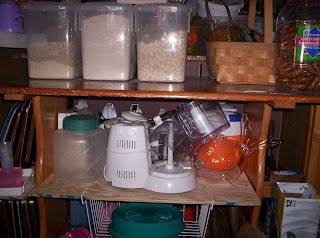
I forgot to get a before, but you can see that I just made a shelf in the middle of the table, straddling the cross brace. I cut some 2"X2" wood to fit on either side of the brace and attached them with some screws to the inside of the legs. Then I put the plywood shelf on top and screwed it into the blocks. When I take this apart, the holes will be on the inside of the legs, under the table, so they will not be visible.
Then I cut a thin shelf and attached it the same way, but I only put blocks in one side of the table (so as to avoid putting any holes in the island itself). This only works because the items for this shelf are very light weight (breakfast trays). I left the other side open for tall items like the lard press (which I use for a cheese press).

Lastly, I made some curtains to go in front and hung them on a dowel rod (one was not long enough, so I cut extra from a second piece and spliced them with tape) and hung this on cup hooks screwed into the underside of the table. I made sure to put two close together where the splice was located. Now I can keep the things that were under there anyway clean and organized as well as other items since I have a shelf.

Next I needed a plan for my entertaining dishes. We have a mismatched set of everyday dishes, and I don't mind that, but we have serving platters and bowls and 'company' dishes that I like to have for guests or for taking things to church. I needed somewhere to put these that would make them accessible but not in my way.
We put a shelf above the hutch and put the entertaining dishes on here. That left us the top of the hutch as a second shelf for items, and these things are pretty to look at as well.

I forgot to get a before, but you can see that I just made a shelf in the middle of the table, straddling the cross brace. I cut some 2"X2" wood to fit on either side of the brace and attached them with some screws to the inside of the legs. Then I put the plywood shelf on top and screwed it into the blocks. When I take this apart, the holes will be on the inside of the legs, under the table, so they will not be visible.
Then I cut a thin shelf and attached it the same way, but I only put blocks in one side of the table (so as to avoid putting any holes in the island itself). This only works because the items for this shelf are very light weight (breakfast trays). I left the other side open for tall items like the lard press (which I use for a cheese press).

Lastly, I made some curtains to go in front and hung them on a dowel rod (one was not long enough, so I cut extra from a second piece and spliced them with tape) and hung this on cup hooks screwed into the underside of the table. I made sure to put two close together where the splice was located. Now I can keep the things that were under there anyway clean and organized as well as other items since I have a shelf.

Next I needed a plan for my entertaining dishes. We have a mismatched set of everyday dishes, and I don't mind that, but we have serving platters and bowls and 'company' dishes that I like to have for guests or for taking things to church. I needed somewhere to put these that would make them accessible but not in my way.

We put a shelf above the hutch and put the entertaining dishes on here. That left us the top of the hutch as a second shelf for items, and these things are pretty to look at as well.
Thursday, March 15, 2007
Closet Space

As I mentioned before, space is at a premium here. We have a medium sized closet, but many of our storage items are in there. I have a dresser, but it is not large enough for all of my clothes. So I began to plan some sort of storage arrangement for my side of the room. I had looked at some wardrobes in catalogs, but they were way too expensive. So this is what I finally devised. Anything can be accomplished with a little creativity (and the willingness to 'settle' for less that originally planned).
First, I bought three of these closet organizers. They are a cottony material and have a large sleeve at the top for hanging. I had an old clothing rack that came apart from the casters, so I leaned it against the wall. Then I built a shelf out of a piece of plywood (spray-painted) and some shelf brackets from the hardware store. Next, I took an old sheet that matched the color of the room and cut it down the middle. I pleated the material as I sewed to help it overlap in the middle and to hide stains, etc. I glued the material to the shelf with hot glue and then glued a piece of cording from the craft dept. over the sewed seams. Viola!
 Costs:
Plywood- free because it was a scrap, but I did buy a sheet for less than $13 to complete other shelves
Spray paint- $2 at the dollar store
Shelf Brackets: $1.00 each, plus about $1.00 for the screws
Cording- $1.03
Closet dividers- $3.oo each at Sav-a-Lot
Sheet- free
Items I already had- sewing machine, thread, glue gun, glue sticks, clothes rack
If need be, you could get a piece of pipe cut at the hardware, two pieces of chain about 12" long, and made the closet to hang from under your shelf (as long as the weight would not be a lot and the shelf was properly anchored)
This is where I store my under things and my sweaters. It is very handy for the commonly used things, and also a nice place to put sweaters, which are seasonal but do not weight much.
Sunday, February 25, 2007
Spring Fever
I am not a fan of hot weather. Once it gets past 70* I have trouble breathing. My very favorite time of year is Fall, followed by winter. I love the idea of being snowed in, with a fire in the fire place (wood stove someday!) and a pot of chicken broth simmering on the stove. And so I am enjoying myself, but I am starting to get excited about all those spring catalogs coming out. We drew up a plan when we first built this house to have an orchard, and this should be the year that becomes a reality. (First, though, we have to finish our pony pasture because one of them broke a sapling I bought and planted in October!)
If I could have anything I wanted, here's what it would include:
Pear Trees
Apple trees
Plum trees
Fig trees
A dwarf lemon that would come inside for winter
Walnut trees
Hickory trees
Almond trees
Raspberry, blueberry, blackberry, and cherry growing along a stone wall
Concord grapes
Canterbury Bells
Purple Hydrangea
Old fashioned lilac
Crimson maples in front of the house
Crape Myrtles along the drive
What will probably really happen is this:
1 apple tree that grows 5 varieties
1 pear tree to replace the one Jack got
Maybe the fig
wild raspberry volunteers already popping up, but along the woods
my grape vine got run over by the mower last year
I have killed 4 Canterbury Bell starts
sugar maple transplants from the woods (free)
Crape Myrtles don't grow in my zone
And while there is nothing wrong with desiring that which is good, I cannot let the probably nots and the nevers get me down. Rather than worry about that grape vine, or the pear tree, or the plants that just won't survive here, shouldn't I ought to worry about those people who do not know Christ? They will wither and die like my Canterbury bells, but the death will be eternal, and I won't have the opportunity to buy another plant and try again. The consequences will be far reaching and much more important than what produce I can grow.
So along with getting excited about my orchard this spring, I am getting excited about the chances I will have to tell others the best news ever. When I prune those trees, I need to mindful of my gentle approach to those who are perishing. When I water the seeds, I need to remember to check back in with those I have left with spiritual things to ponder. And when my trees begin to produce fruit, I had better have an abundant crop in my heart of eternal 'gardening' done for the Lord. Because while he wants me to care for my family the best way I can and work hard, he will not ask me on that Great Day how my trees are doing. Spring has sprung, but for me it needs to be checked to be sure it is in perspective!
Only one life, t'will soon be past. Only what's done for Christ will last. -Unknown
If I could have anything I wanted, here's what it would include:
Pear Trees
Apple trees
Plum trees
Fig trees
A dwarf lemon that would come inside for winter
Walnut trees
Hickory trees
Almond trees
Raspberry, blueberry, blackberry, and cherry growing along a stone wall
Concord grapes
Canterbury Bells
Purple Hydrangea
Old fashioned lilac
Crimson maples in front of the house
Crape Myrtles along the drive
What will probably really happen is this:
1 apple tree that grows 5 varieties
1 pear tree to replace the one Jack got
Maybe the fig
wild raspberry volunteers already popping up, but along the woods
my grape vine got run over by the mower last year
I have killed 4 Canterbury Bell starts
sugar maple transplants from the woods (free)
Crape Myrtles don't grow in my zone
And while there is nothing wrong with desiring that which is good, I cannot let the probably nots and the nevers get me down. Rather than worry about that grape vine, or the pear tree, or the plants that just won't survive here, shouldn't I ought to worry about those people who do not know Christ? They will wither and die like my Canterbury bells, but the death will be eternal, and I won't have the opportunity to buy another plant and try again. The consequences will be far reaching and much more important than what produce I can grow.
So along with getting excited about my orchard this spring, I am getting excited about the chances I will have to tell others the best news ever. When I prune those trees, I need to mindful of my gentle approach to those who are perishing. When I water the seeds, I need to remember to check back in with those I have left with spiritual things to ponder. And when my trees begin to produce fruit, I had better have an abundant crop in my heart of eternal 'gardening' done for the Lord. Because while he wants me to care for my family the best way I can and work hard, he will not ask me on that Great Day how my trees are doing. Spring has sprung, but for me it needs to be checked to be sure it is in perspective!
Only one life, t'will soon be past. Only what's done for Christ will last. -Unknown
Thursday, February 22, 2007
Spices
One time when I was about 13, I was making dinner for the family and needed some spices. Our spices were always in that little cupboard above the stove, so I climbed on a chair and proceeded to hunt for the correct bottle. My sister was in the kitchen with me, and a sudden gasp alerted me to the fact that my apron had caught fire! :0 Because I had the stove on and also a long apron, when I leaned over to find the spices, I caught myself on fire!
I jumped off the chair and tried to get the apron off in vain- it was tied in a knot. After several agonizing seconds, the flames were extinguished with dirty dish water!
Aside from a very valuable lesson about aprons and the stove, I learned not to store spices above the stove for several reasons (some I learned later in life):
1. Spices deteriorate quickly in temperature extreme.
2. Spices knocked to the back of the cupboard were virtually unreachable.
3. Spices in the front row were visible- nothing else was.
4. Searching for a spice could cause another jar to be knocked off, into a pot of something below.
5. Critters (insects) could invade the spice cupboard with little detection.
So when I was married and we moved into our house, I had in mind to do something different with my spices. We have an island, and the island contained five small drawers. The middle one is good for rolls of waxed paper, aluminum foil, and take-out menus. The other four drawers were converted to hold spices. The drawers were not deep enough, so I asked my dad to take the fronts off of two drawers and make a tall, false front for the one (kinda like buildings used to be, with very tall fronts and nothing behind them). The end result was two deep drawers that still looked like 4, and great room for spices.

Another benefit of this plan was the easy accessibility to the spices while cooking, and the visibility of everything at a glance. I bought some white file labels, cut them in half, and with my permanent marker (thin line, of course!) I labeled the spices. It is also good to put the date of opening so you have an idea how long to keep it, though some of the spices here are used up long before they would go bad. Extra jars are left unopened in a different cupboard.

To the right, you can see our apple bin, and to the left is a leaf from the roses my husband bought me. I love yellow roses, but I don't get them very often because I am actually allergic to them!

You can see my Indian Spices in the little envelopes in front, and my nutmeg grinder and nut in a baggie.
I jumped off the chair and tried to get the apron off in vain- it was tied in a knot. After several agonizing seconds, the flames were extinguished with dirty dish water!
Aside from a very valuable lesson about aprons and the stove, I learned not to store spices above the stove for several reasons (some I learned later in life):
1. Spices deteriorate quickly in temperature extreme.
2. Spices knocked to the back of the cupboard were virtually unreachable.
3. Spices in the front row were visible- nothing else was.
4. Searching for a spice could cause another jar to be knocked off, into a pot of something below.
5. Critters (insects) could invade the spice cupboard with little detection.
So when I was married and we moved into our house, I had in mind to do something different with my spices. We have an island, and the island contained five small drawers. The middle one is good for rolls of waxed paper, aluminum foil, and take-out menus. The other four drawers were converted to hold spices. The drawers were not deep enough, so I asked my dad to take the fronts off of two drawers and make a tall, false front for the one (kinda like buildings used to be, with very tall fronts and nothing behind them). The end result was two deep drawers that still looked like 4, and great room for spices.

Another benefit of this plan was the easy accessibility to the spices while cooking, and the visibility of everything at a glance. I bought some white file labels, cut them in half, and with my permanent marker (thin line, of course!) I labeled the spices. It is also good to put the date of opening so you have an idea how long to keep it, though some of the spices here are used up long before they would go bad. Extra jars are left unopened in a different cupboard.

To the right, you can see our apple bin, and to the left is a leaf from the roses my husband bought me. I love yellow roses, but I don't get them very often because I am actually allergic to them!

You can see my Indian Spices in the little envelopes in front, and my nutmeg grinder and nut in a baggie.
Monday, February 12, 2007
Having a Pantry
This writing would seem at first to belong in the food section, but it is a home matter because being prepared is key to having a smoothly-run home. It is also about more for me than food. The 'pantry' is my supply of whatever I think I would need to care for my family if I could not get to a store for a month. Food is certainly one of the most essential, but there are many others that would be important. Here are the various pantry categories I have, and what is in each:
Food-
Ideally you would have many meats and staples in your freezer or outside on the vine, but I am talking about middle of winter when there is nothing growing and the electric might be out, causing the items in the freezer to thaw and become spoiled or there is no way to cook them. It's a 'catch 22'= if you have the fuel to heat your home, the frozen foods will thaw, and if you have a cold enough house to keep things from thawing, you probably don't have a heat or cooking source.
So, in case there is no way to keep frozen or fresh foods or a way to cook them, here is what I recommend having on hand (consider your portion sizes and the number of people in your home):
sardines- good meat source, very cheap, come in a variety of flavors (avoid the ones in soybean oil)
canned spinach- great place to get your iron when fresh salad greens are inaccessible
canned sweet potatoes or pumpkin pie filling- several vitamins, as well as some yummy taste
dried fruit- we have an assortment of raisins, figs, dates, dried apples, banana chips, and coconut. Just remember that dried fruit's sugar is highly concentrated, so watch how much you eat
nuts- pistachios, peanuts, pecans, walnuts, filbert, etc. Great fat source and very versatile. Also good to add to this group are seeds- sunflower, pumpkin, etc.
olive oil- source of fat as well as a possible internal lubricant in case of constipation.
oats- we buy 25 lb. bags of thick rolled oats from the co-op. These are very versatile and even alone make a filling breakfast. SOAK YOUR OATS OVERNIGHT! Even if the directions do not say to, it will make digestion easier. Soaked oats can be eaten without cooking if you really have to.
Health and Medicinal-
Along with all the items that would be in my First Aid Kit (see Hope Chest section on the right), it is good to have some other helpful items in case of 'blizzard, drought, or war':
honey- anything with good bacteria in it will help to keep your digestive system alive, but many of these things, such as yogurt, are impossible to keep without refrigeration. Honey has enzymes in it that help the body but does not need special storage arrangements (NOTES: do not give honey to a child under 1 year of age, and make sure your honey is real, or raw, and not pasteurized)
red wine- even for those who believe in temperance, wine is a good medicine and is stated as so in the Bible (1 Timothy 5:23) Also contains good enzymes
bleach- while it is important not to over-use chlorinated products, they are very helpful in clearing a home of germs in time of need. We had a roto-virus mini-epidemic last spring, and a jug of bleach was very handy. A weak bleach solution (1 capful for each gallon) makes a rinse for dishes that will kill any germs. The same is true for any communal surfaces that would be exposed repeatedly- the bathtub, toilet, sink, table (as long as it is not a fragile fine wood finish)
soap- washing almost anything will improve the situation it is in. For clothes and dishes, use a mild a soap as possible, especially if hot water is not readily obtainable. The same is true for the body, where washing off too much of the essential oil creates a gateway for more invasion. I buy all my bath soap at www.lazybeestudio.com The bars last longer than ones from the store, so the price evens out.
peppermint tea- not only good for stomach aches and sore throats, peppermint is a natural antiseptic. Be careful not to get a bunch of tea leaves in a cut or open sore, though! A hot, squeezed tea bag is good for eye infections and boils.
chapstick and lotion- both are very soothing in a situation where skin is exposed to temperature extremes
Misc.-
batteries- I try to keep 4 of every size battery on hand, because you never know which ones you will need
oil lamps- the discount store here has some that are only $3.00, and the oil refills are $2.00 a bottle. They work very well, especially for the money, and are safer than candles
matches- if you are lucky enough to have fuel for heat or light, you will need a way to light it
toilet paper- not essential, but a great luxury regardless of where you end up having to go
extra blankets and sheets- we have a closet completely reserved for these items, and when the gas line troubles came to us, we sure were glad to have those extra blankets! Old sheets can also be ripped into strips for bandages, masks, or diapers in a pinch.
February 20th, 2007- In a very odd chain of 'clicks', I found a new blog to view today, and on this block is a link to a website about being prepared. I went to the website, http://www.backwoodshome.com/articles/hagan59.html, and was suprised to see many of the things on my list also included in the authior's list of important staples to have on hand. There were some differences, such as his use of tuna rather than sardines and the use of white flour and rice (brown is better in both), but it was nce to see that my own 'gut' instinct was comparable to this researched list!
Food-
Ideally you would have many meats and staples in your freezer or outside on the vine, but I am talking about middle of winter when there is nothing growing and the electric might be out, causing the items in the freezer to thaw and become spoiled or there is no way to cook them. It's a 'catch 22'= if you have the fuel to heat your home, the frozen foods will thaw, and if you have a cold enough house to keep things from thawing, you probably don't have a heat or cooking source.
So, in case there is no way to keep frozen or fresh foods or a way to cook them, here is what I recommend having on hand (consider your portion sizes and the number of people in your home):
sardines- good meat source, very cheap, come in a variety of flavors (avoid the ones in soybean oil)
canned spinach- great place to get your iron when fresh salad greens are inaccessible
canned sweet potatoes or pumpkin pie filling- several vitamins, as well as some yummy taste
dried fruit- we have an assortment of raisins, figs, dates, dried apples, banana chips, and coconut. Just remember that dried fruit's sugar is highly concentrated, so watch how much you eat
nuts- pistachios, peanuts, pecans, walnuts, filbert, etc. Great fat source and very versatile. Also good to add to this group are seeds- sunflower, pumpkin, etc.
olive oil- source of fat as well as a possible internal lubricant in case of constipation.
oats- we buy 25 lb. bags of thick rolled oats from the co-op. These are very versatile and even alone make a filling breakfast. SOAK YOUR OATS OVERNIGHT! Even if the directions do not say to, it will make digestion easier. Soaked oats can be eaten without cooking if you really have to.
Health and Medicinal-
Along with all the items that would be in my First Aid Kit (see Hope Chest section on the right), it is good to have some other helpful items in case of 'blizzard, drought, or war':
honey- anything with good bacteria in it will help to keep your digestive system alive, but many of these things, such as yogurt, are impossible to keep without refrigeration. Honey has enzymes in it that help the body but does not need special storage arrangements (NOTES: do not give honey to a child under 1 year of age, and make sure your honey is real, or raw, and not pasteurized)
red wine- even for those who believe in temperance, wine is a good medicine and is stated as so in the Bible (1 Timothy 5:23) Also contains good enzymes
bleach- while it is important not to over-use chlorinated products, they are very helpful in clearing a home of germs in time of need. We had a roto-virus mini-epidemic last spring, and a jug of bleach was very handy. A weak bleach solution (1 capful for each gallon) makes a rinse for dishes that will kill any germs. The same is true for any communal surfaces that would be exposed repeatedly- the bathtub, toilet, sink, table (as long as it is not a fragile fine wood finish)
soap- washing almost anything will improve the situation it is in. For clothes and dishes, use a mild a soap as possible, especially if hot water is not readily obtainable. The same is true for the body, where washing off too much of the essential oil creates a gateway for more invasion. I buy all my bath soap at www.lazybeestudio.com The bars last longer than ones from the store, so the price evens out.
peppermint tea- not only good for stomach aches and sore throats, peppermint is a natural antiseptic. Be careful not to get a bunch of tea leaves in a cut or open sore, though! A hot, squeezed tea bag is good for eye infections and boils.
chapstick and lotion- both are very soothing in a situation where skin is exposed to temperature extremes
Misc.-
batteries- I try to keep 4 of every size battery on hand, because you never know which ones you will need
oil lamps- the discount store here has some that are only $3.00, and the oil refills are $2.00 a bottle. They work very well, especially for the money, and are safer than candles
matches- if you are lucky enough to have fuel for heat or light, you will need a way to light it
toilet paper- not essential, but a great luxury regardless of where you end up having to go
extra blankets and sheets- we have a closet completely reserved for these items, and when the gas line troubles came to us, we sure were glad to have those extra blankets! Old sheets can also be ripped into strips for bandages, masks, or diapers in a pinch.
February 20th, 2007- In a very odd chain of 'clicks', I found a new blog to view today, and on this block is a link to a website about being prepared. I went to the website, http://www.backwoodshome.com/articles/hagan59.html, and was suprised to see many of the things on my list also included in the authior's list of important staples to have on hand. There were some differences, such as his use of tuna rather than sardines and the use of white flour and rice (brown is better in both), but it was nce to see that my own 'gut' instinct was comparable to this researched list!
Subscribe to:
Posts (Atom)

